
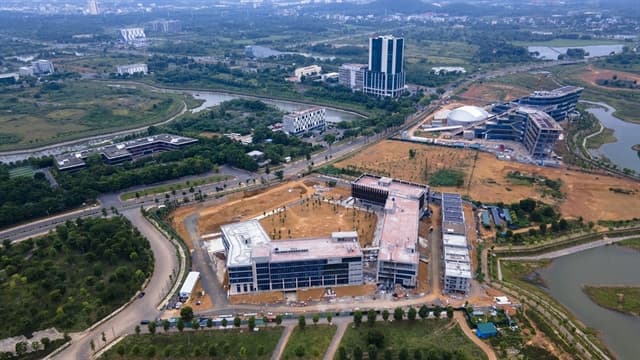
Hanoi is shifting its foreign direct investment strategy from volume to quality, prioritising high technology, semiconductors, digital infrastructure and green industry.
According to the Hanoi Department of Finance, the city had attracted more than US$4 billion in foreign direct investment by September 2026. That was 90.38 per cent of the annual target and 105.8 per cent of the figure for the same period last year.
The city is accelerating large domestic technology projects to build an innovation ecosystem. Earlier this year, Hanoi authorities and FPT Group began building a digital technology park in Tây Tựu and Phú Diễn wards. The project has total investment of VNĐ50 trillion (US$1.95 billion) and is expected to attract about 60,000 experts, digital engineers and other innovation workers.
Viettel Group broke ground on a semiconductor chip manufacturing plant at Hoà Lạc High-Tech Park and invested in large data centres in Hoà Lạc and An Khánh communes.
The city granted an investment certificate to G-Campus Hoà Lạc, developed by G-Group. It includes a high-tech complex and a Tier III data centre for artificial intelligence and high-performance computing. Total investment is nearly VNĐ7.6 trillion (US$300 million).
New growth drivers
Hanoi will prioritise multinational corporations, strategic investors and projects in artificial intelligence, big data, cloud computing, semiconductors, quantum technology, biomedicine and environmental technology.
The city plans to develop research and development centres, innovation hubs, financial and commercial centres, logistics facilities and green industrial parks. Hoà Lạc High-Tech Park is expected to become a research and innovation hub for global technology corporations.
Hanoi will complete infrastructure for its high-tech biotechnology park, develop clean industrial parks in Sóc Sơn, Đông Anh, Phú Đổng and Phụng Hiệp, and study a possible free trade zone and large logistics centres.
Investment attraction will follow a polycentric model. The Nhật Tân–Nội Bài corridor will prioritise regional headquarters, finance, commerce and logistics. The urban core will focus on finance, consultancy and cultural industries, while the northern, eastern and southern hubs will focus on high-tech manufacturing and logistics.
For 2026–2030, Hanoi aims to attract US$25 billion in registered foreign direct investment and about US$16 billion in disbursed capital.
About 80 per cent of new investment is expected to come from developed economies. Hanoi aims for high-tech industries, innovation, research and development, and green manufacturing to account for 50 per cent of new investment. High-tech projects must include commitments to technology transfer and workforce training.
The city aims to raise the average localisation rate in key industrial sectors to 45 per cent and bring about 350 domestic enterprises into foreign-invested companies' value chains. Thirty are expected to become tier-one suppliers.
Hanoi targets a 40 per cent share of eco-industrial parks and a workforce training rate of 80–85 per cent. By 2030, the foreign-invested sector is expected to contribute 11–12 per cent of the city's gross regional domestic product.
To reach these targets, Hanoi will refine its institutional and policy framework, explore special mechanisms and launch controlled pilot schemes in artificial intelligence, semiconductors, biotechnology and green finance.
Investment incentives will increasingly be linked to technology, research and development, added value, land-use efficiency, emissions and budget contributions, rather than investment scale or location alone.
Combining high-quality investment with workforce development, technological innovation and stronger domestic businesses is intended to support Hanoi's digital economy and green growth.
Sources: Viet Nam News

