
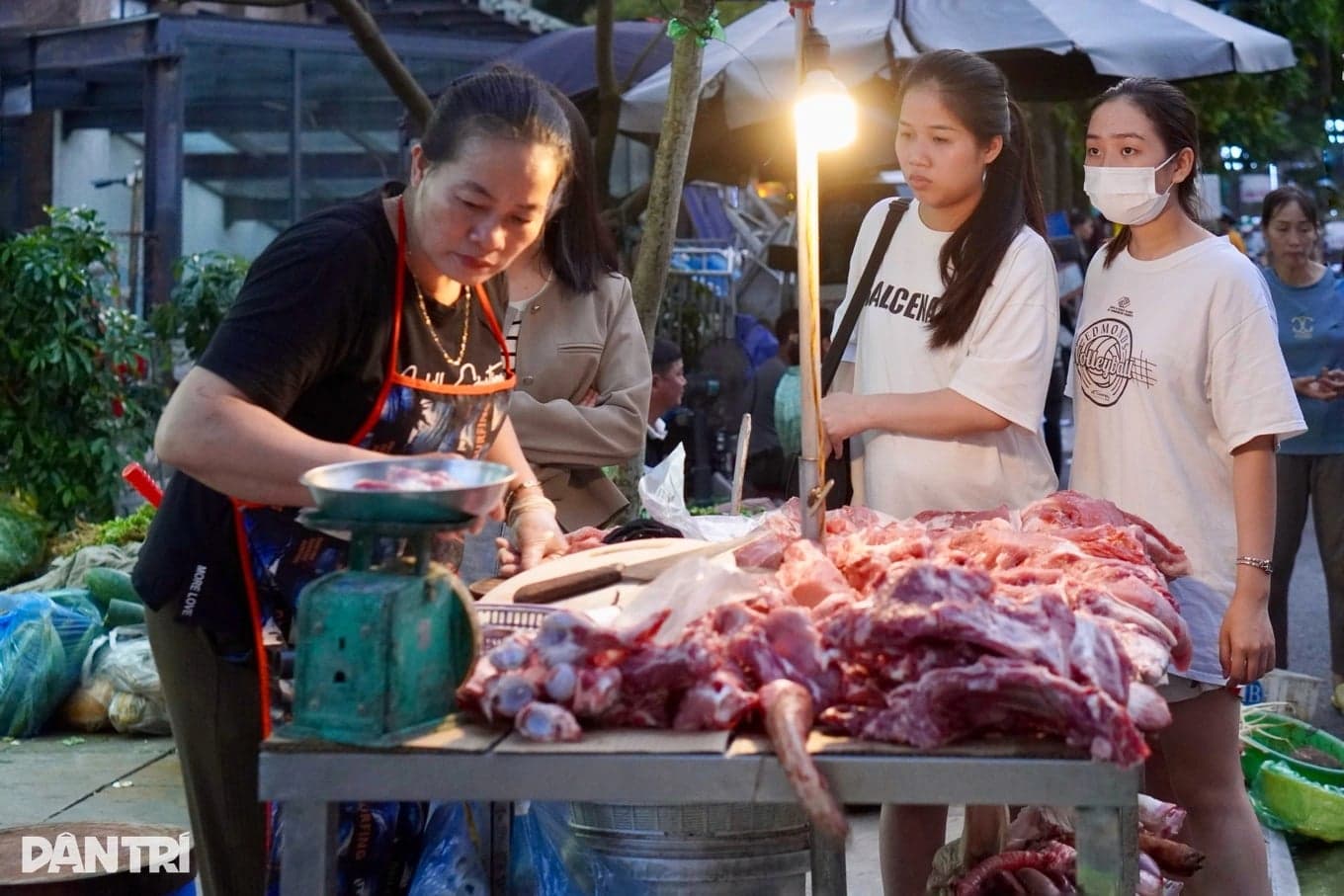
The Hanoi People's Committee approved Plan No. 426/KH-UBND to pilot a food safety management and food traceability system in the city.
The system will track the origin of livestock and poultry meat, with priority given to pork, to monitor food from slaughtering and transport through distribution and sale.
The project is intended to create a unified traceability database. It will help authorities monitor risks, identify problems, contain them and recall products when a food safety incident occurs.
The pilot will cover 20 sales points and five collective kitchens
At the first stage, Hanoi plans to select at least two complete food supply chains.
Each chain will include two farms, two centralized slaughterhouses, two distributors or primary processing facilities, transport operators, 20 sales points and five collective kitchens.
At least 10 of the 20 sales points will be small traders at markets. The city will also select three to five communes or wards with businesses taking part in the supply chains.
The system will work on mobile phones and web browsers. After training, traders will be able to receive, split and transfer batches.
For consumers, Hanoi plans to integrate food-origin checks into the iHanoi application and the city's electronic portal instead of requiring a separate app.
Information about origin, documents, slaughtering, transport and distribution will be recorded for each batch so it can be checked and compared when needed.
During the pilot, the city will not require businesses to keep detailed daily farming logs. They will only need to record identification details and the code of a batch sent for sale or entering slaughtering.
For food supplied from outside Hanoi, origin will be established through valid documents, without waiting for an interprovincial data connection.
The system is also planned to connect and share data with existing traceability platforms, including check.hanoi.gov.vn, HanoiCheck and specialized databases.
A batch QR code may be temporarily locked
The plan includes testing an emergency process for food that may pose a safety risk.
If a risky batch or an incident is detected, the relevant regulator may issue a system command to temporarily stop the batch from circulating or lock its QR code.
This will help authorities quickly identify businesses that received or distributed the affected products, then contain the issue, trace the goods and organize a recall.
The system will compare data daily to detect batches with missing documents, quantity discrepancies or incorrectly used codes.
Participating businesses will be responsible for the accuracy of the information entered into the system. Commune-level authorities will review and inspect it within their powers.
To support the launch, the city requires in-person training for businesses by production shift, including night and early-morning shifts. Participants will receive help setting up accounts, forms and data connections.
The Hanoi Department of Science and Technology will coordinate the project with other departments and local authorities.
Within seven working days of the plan being issued, agencies must review the current situation and finalize the list of pilot participants.
The system must be built and integrated within 15 working days of the plan's issuance. The pilot will run for at least 15 days, with an evaluation planned for November.
The results will be assessed by data accuracy, incident response time, the effectiveness of warnings, tracing and recalls, and operating costs.
Hanoi will then refine the system's management and operating procedures and consider expanding it to other food groups.
Sources: Dân Trí

