
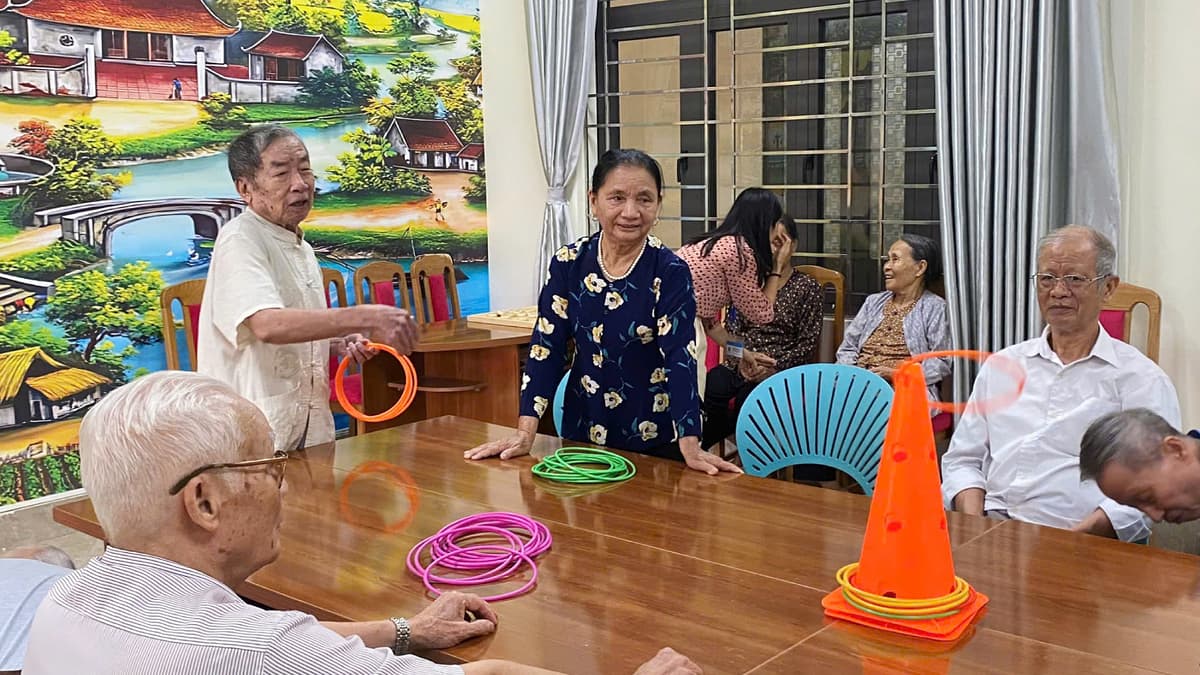
More than three months after the centre in Quoc Oai commune opened, 89-year-old Tran Thi Can and 87-year-old Nguyen Van Khanh had not missed a day. Their lives had previously revolved around the television. Khanh disliked getting up, rarely interacted with others and needed help walking. He now uses an arm exercise machine, pedals for half an hour, laughs and claps along with the music. Can joins every activity and sings in front of the group.
“We are used to this routine now. If the centre closes, we will not know where to go,” Can said.
Every morning, 67-year-old Do Thi Dac rides a motorbike with three friends from Kieu Phu commune, two kilometres away. She used to farm and make conical hats, spending most of her time at home and avoiding crowded places. After several trial visits, she became a regular.
The Quoc Oai centre is one of six facilities operating under Hanoi’s Plan 306. The first opened in June in Long Bien district. Others followed in Thach Than in Quoc Oai commune, Quang Trung in Dong Da district, Giang Bien 3 in Viet Hung ward, Quang An in Tay Ho district and Gia Thuy in Bo De ward.
The Quoc Oai model follows the local rural routine. Older people spend the morning at the centre and return home because meals are not provided. The centre receives about 40 people a day.
Demand exceeds capacity
In inner Hanoi, demand is well above capacity. Mai Huong said she waited nearly a month to register her 79-year-old father, Nguyen Van Khoi, at the Tay Ho centre, which had been full since the trial stage.
Participants try not to miss sessions because they fear losing their places. Tao Hang said her aunt, Tao Thi Chinh, had shown signs of depression after taking many medicines for a long period. After 12 days at the day-care centre, she talked more, described her classes and used new routines at home. Her niece said she looked forward to going every morning but worried that staff might not accept her the next day.
A similar situation exists at the Bo De centre. It has five rest rooms, 20 large beds and seven staff members, so it cannot accept everyone who applies. Manager Mai Thi Phuong said the centre had introduced rotation because demand was high. After five trial days, older people temporarily give up their places to new participants. Priority goes to people aged 70 to 75 who can care for themselves.
Hanoi has more than 1.3 million older people, or 16% of its population. The current care system meets only 3% to 5% of demand. After the pilot, the city plans to have day-care facilities in 70% of communes and wards by 2030.
Activities at the centres
The model combines medical care with social activities. Staff create electronic records, measure blood pressure and blood sugar, provide physiotherapy, foot baths, yoga and balance exercises.
In the afternoon, participants receive massage and acupressure based on traditional medicine. Staff also teach them to use smartphones, make video calls, complete administrative procedures online and recognise online scams.
Eighty-six-year-old Nguyen Dinh Long was able to walk with a cane on his own after two weeks at the Bo De centre. The article said many older people who had shown signs of depression, withdrawal or cognitive decline changed their routines, started talking to others and became more open with their families.
For Mai Huong’s family, the biggest change was her father’s openness. After retiring as a ship captain, he spoke little and experienced cognitive decline. On the third day after a class, he replied to his wife’s greeting, which pleased the family.
Eighty-four-year-old Luong Van Chanh cycles to the Quoc Oai centre in all weather. He likes the exercise machines, an electric treatment in the traditional medicine room and a ring-toss game, where he hits the target nine times out of ten. He is now learning Chinese chess. He said he felt more sluggish after spending the two weekend days at home without social contact.
The cost question
Rising demand has raised questions about operating costs and future fees. VnExpress reported that the Long Bien centre estimates its cost at VND5.5 million per month, while Bo De plans to charge VND2.5 million. Participants in Tay Ho currently pay VND100,000 per day. Quoc Oai does not charge because it does not provide meals, but it lacks consumable supplies.
Some retired people said they would have to reconsider their spending if fees were introduced. They want prices comparable to public kindergartens so families do not face an excessive burden.
The centres need money for meals, medicines, herbs for foot baths, security and cleaning, as well as specialists who lead exercises and acupressure sessions.
Nguyen Dinh Khuyen, secretary of the Tay Ho Party Committee and chair of its People’s Council, said the centres were currently funded mainly through social contributions and partly from the budget. Because the city has not set specific funding standards, the districts will evaluate the pilot and submit a report.
Tay Ho authorities support the model and want to expand it after the evaluation. Its long-term operation, however, depends on funding. “As long as social funding is available, running the centre is relatively easy. Once fees are introduced, maintaining the model will be more difficult,” Khuyen said.
Sources: VnExpress

