
Hanoi's area and population have changed considerably since the city was founded. The 2025 statistical yearbook puts the city's area at about 3,360 square kilometres and its population at around 8.7 million.
The Old Quarter covers only about 81 hectares within the current conservation boundary. Its population grew quickly over several decades while the housing stock barely expanded. About 66,600 people lived there in 2010, a density of 823 people per hectare, among the highest in historic urban areas worldwide.
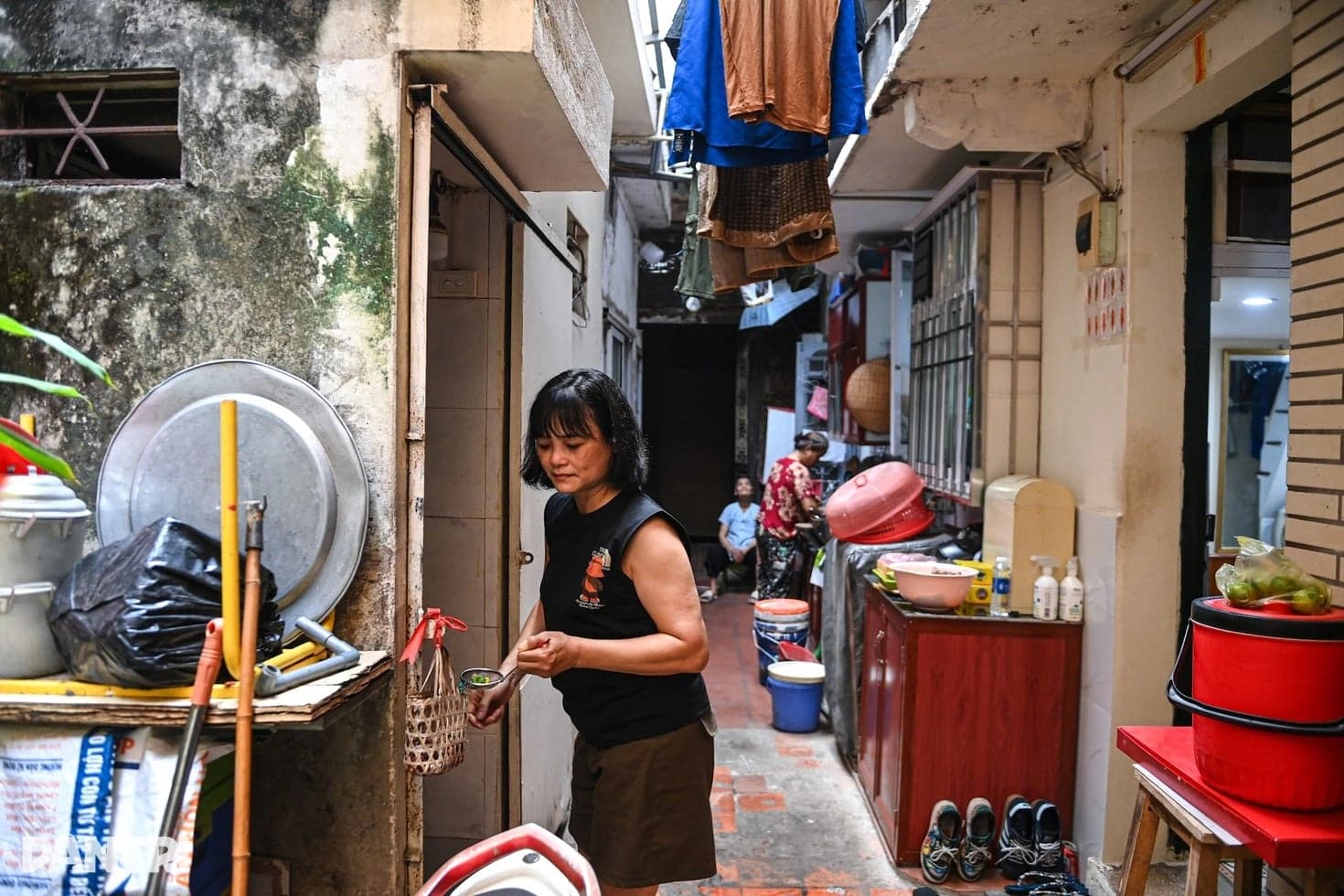
Housing policy during the centrally planned period placed many households in the same buildings, sharing courtyards, kitchens and toilets. As the number of residents grew, rooms were divided into smaller spaces. Some households eventually had only one cramped room with poor sanitary conditions.
Twenty-eight years without a working relocation scheme
Architect Dao Ngoc Nghiem, a former director of Hanoi's Department of Planning and Architecture, said relocation from the Old Quarter was already included in the 1992 master plan. In 1998, the city approved a policy aimed at reducing density to 500 people per hectare by 2020. It called for about 6,550 households, or more than 26,000 people, to move.
The scheme had two stages. From 2013 to 2016, 1,530 households were to move to an 11.12-hectare resettlement housing area in Viet Hung urban area, formerly in Long Bien District. The second stage, planned through 2020, would move the remaining 5,020 households to a 30-hectare site in the former Thuong Thanh area.
The housing complex in Viet Hung was completed, but almost no Old Quarter residents moved there. In Submission No. 434/TTr-UBND dated October 27 on a proposed city council resolution for people facing housing difficulties in the Old and French quarters, the Hanoi People's Committee acknowledged that the relocation scheme launched in 2013 had not been implemented. It identified the lack of suitable housing as the main reason.
Why did the scheme fail to take hold?
The official explanation, including the shortage of suitable housing, belongs to the responsible authorities. The author, who was born and raised in the Old Quarter, believes livelihoods are one reason. Many residents earn money from ground-floor shops, street vending or rooms rented to tourists. Moving to an upper-floor apartment 7 kilometres from Hoan Kiem Lake would mean losing that income, even if the living area increased several times. As many specialists have said, relocation must address livelihoods as well as floor space.
Property value is another issue. Real estate in the Old Quarter is very expensive, so residents naturally need to consider whether their property will retain comparable value after they move to a resettlement apartment.
Hanoi's 100-year master plan, approved by the city People's Committee on May 13, aims to restructure the city and reduce pressure on the historic inner city. On October 28, the city council passed a resolution allowing the households with the greatest housing difficulties in the Old and French quarters of Hoan Kiem Ward to buy or rent social housing without a lottery. There are now 902 households, or 3,621 people, living in multi-household buildings. Average floor area is below 5 square metres per person.
Each household will receive one apartment once. The city plans to allocate 552 apartments in nine projects in 2026, with no more than 20% of the apartments in any project assigned to the scheme. The remaining apartments are planned for 2027. Buyers must move all household members out of the old home and register their permanent residence at the new address. The privately owned old space will be handled under a plan set by the city People's Committee. The state will not pay directly; residents will pay the social-housing price and may take preferential loans.
Unlike the earlier scheme, the new mechanism uses completed or nearly completed social-housing projects instead of waiting for a separate relocation complex to be built.
At its October 2026 session, the city council also approved the investment policy for a project to renovate, improve and restructure the area around Hoan Kiem Lake. The city is pursuing measures to preserve heritage, improve the urban environment and attract social resources for economic and social development.
Balancing tourism and conservation
The Old Quarter attracts tourists and has strong commercial value. Over the years, many old houses have been demolished for restaurants, hotels and bank offices. Earlier statistics listed 1,081 protected structures, including more than 200 houses of special historic value. The authorities should establish how many remain today, but the author says there are far fewer old houses than before.
The measure for 902 households is needed to preserve part of old Thang Long and reduce pressure on the quarter's infrastructure. At the same time, the city must address the balance between tourism and conservation. If tourism grows without effective management, every square metre of the Old Quarter will be used to maximise profit. That would draw more people into the area and make relocation harder.
Reconciling tourism with conservation will require firm management measures.
First, pavements should be returned to pedestrians, and businesses should not be allowed to use them for trading. Within the powers granted by the Capital Law, the city could set minimum floor areas for food and accommodation businesses in the Old Quarter.
Second, restaurants and accommodation providers should face stricter food-safety and fire-prevention standards. Businesses that fail to meet them should be removed, while the number of accommodation facilities and guests should be controlled to prevent overload.
Third, the city should enforce planning and architectural rules on building height and setbacks, remove illegally added floors and relocate government offices and major hospitals out of the area.
Fourth, the city should publish an early and clear plan for the old homes after residents move out. This would allow people to make decisions in advance.
If these measures are enforced, the number of tourists staying in the Old Quarter may fall. Hanoi's total tourist numbers would not necessarily be affected: visitors could eat and stay in other parts of the city and come to the Old Quarter to sightsee.
That approach could relocate residents, preserve the Old Quarter and support sustainable tourism in the city at the same time.
The author, Dr Quan The Dan, graduated from Hanoi Medical University in 1983 and worked in treatment and teaching at several medical institutions in Ho Chi Minh City and Hanoi. After retirement, he continued working in private healthcare.
Sources: Dân Trí

