
The plan covers two national railway projects and five urban lines. Households whose residential land is recovered would also receive priority for temporary resettlement under city rules.
Strategic contractors would work with local authorities and relevant agencies to persuade households and organisations in the project areas to hand over sites voluntarily. This would take place alongside inventory, compensation, support and resettlement work.
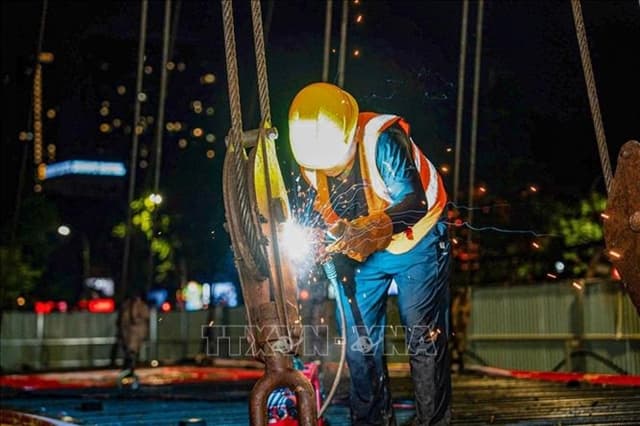
Construction of the five urban lines began in June, with basic completion expected in 2030. The two national projects, the realignment of the Phu Xuyen, Ngoc Hoi section of the Hanoi, Ho Chi Minh City railway and the Ngoc Hoi, Kim Son section of the Eastern Ring Railway, broke ground on September 2. They are expected to be completed in 2027.
The lines covered by the plan
The urban projects are Line 1, from Thuong Phuc through the Railway Industrial Zone, Ngoc Hoi, Hanoi Station and Yen Vien to Noi Bai Airport; Line 2, from Noi Bai Airport through Nam Thang Long, Tran Hung Dao and Thuong Dinh to Hung Vuong Stadium; Line 8, from Hoa Lac through Son Dong, Mai Dich, Ring Road 3, Linh Nam and Thuan An to Gia Binh Airport; Line 10, from Vo Chi Cong Street through Ring Road 2.5 and Vinh Tuy to Dong Anh; and Line 14, from Thang Long Bridge through Hong Ha and Gia Lam to Nghia Tru.
Special contractor process
Under the draft, a strategic contractor would be a selected domestic company prepared to carry out the capital's major railway projects. The municipal Party Committee's executive committee would designate it. The contractor would remain involved until all contractual obligations were completed.
Strategic contractors would not undergo capacity, experience, technical or financial assessments under the bidding law. The investor would use a streamlined direct appointment process, while proposed contractors would still have to meet the law's eligibility requirements.
Before signing a contract, a contractor would have to commit to cutting the approved package price by at least 15% for urban railway projects, including transit-oriented development projects, and by at least 10% for national railway projects. Contractors would also have to meet schedule and quality requirements and could not abandon the work or end the contract unilaterally.
The draft requires contractors to waive the right to sue or lodge complaints against the State or State agencies before the arbitration bodies and courts listed in the document.
Under the capital's 100-year master plan, Hanoi's urban railway network will cover about 979km. Including national and inter-regional railways, the full system will total nearly 1,200km. Hanoi currently operates the Cat Linh, Ha Dong line and the elevated section of the Nhon, Hanoi Station line. The city plans to invest in about 500km of urban railway by 2035 and complete the remaining 479km between 2036 and 2045.
Sources: Viet Nam News

