
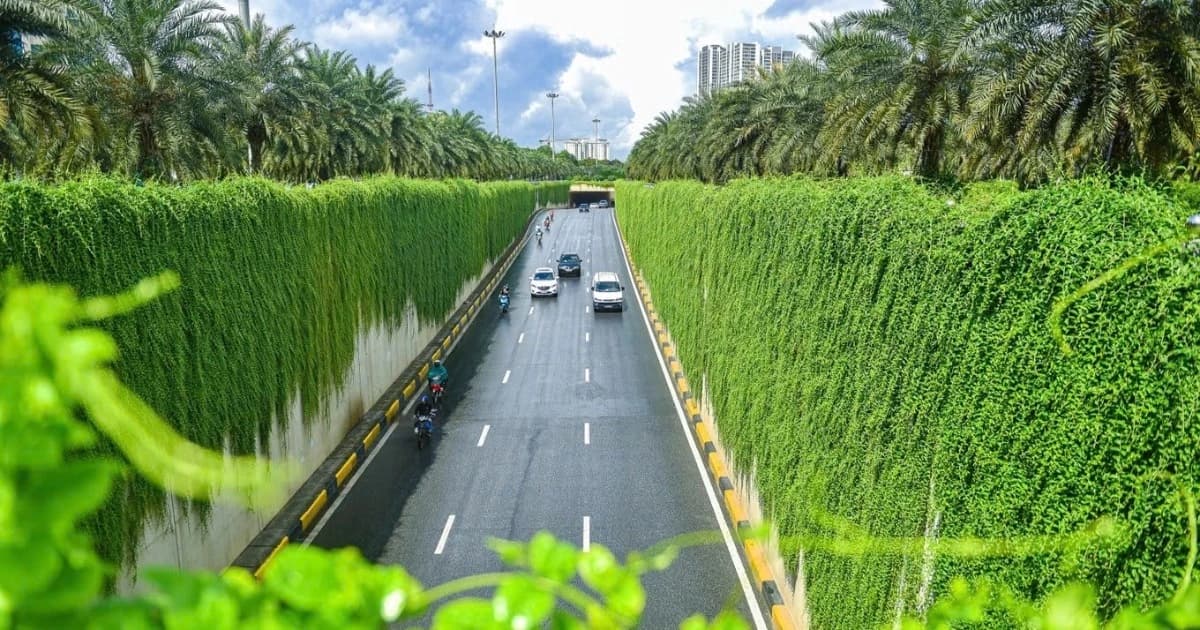
Hanoi’s Department of Construction has asked relevant units to design planting and landscaping measures for several urban infrastructure sites.
The pilot covers three elevated railway pillars on Nguyen Trai Street near Royal City, the Le Van Luong–To Huu underpass, the Le Van Luong–Lang Ha flyover and three bus stops: near the University of Pharmacy on Le Thanh Tong Street, near Saint Paul Hospital on Tran Phu Street and stop No. 69 on Ly Thuong Kiet Street.
Work is under way and is expected to be completed by October 10.
For the railway pillars, officials plan to install steel frames around the structures without drilling into the concrete. A gap will separate each frame from the pillar so plants can grow and the structure can be inspected.
Plants will be placed at the base and guided up the frames. They must not reach the crossheads, beams or technical equipment. Staff will trim the branches and inspect the frames, connections and growth area regularly to protect the structures and public safety.
For the Le Van Luong–To Huu underpass, the plan covers about 200 square metres of climbing frames divided into modules or sections. Soil will be improved and plants grown along the existing landscaped strip.
The steel frames will stand on supports fixed in the soil near the wall. Their upper parts will be attached to the railing with expansion bolts spaced 2 to 3 metres apart. A special sealant will be used to strengthen the joints and prevent water from entering the structure. Plants must not spread onto the road, lights, signs or technical equipment.
Modular planters will be placed along the upper edge of the underpass wall beneath the railing for a total length of about 300 metres. They will be fixed with rust-resistant expansion bolts and sealant, then connected to one another with steel fasteners.
Hanging plants will grow along the inner wall. Their length will initially be limited to about 2 to 3 metres and they will be trimmed regularly so they do not obstruct traffic clearance, signs, lighting or technical equipment. Watering must not stain the walls.
At the bus stops, planters will be placed behind or beside the shelters without blocking pedestrian routes. Light frames and cables will guide climbing plants up the rear wall and part of the roof. Independent structures or attachments approved by the site operator will be preferred.
Hanoi has invested in greenery, parks, flower gardens and streetscape improvements in recent years. The project is based on the idea that combining plants with technical infrastructure can give one public space several functions while reducing pressure on scarce urban land.
In its strategy after 2030 and its 100-year vision, Hanoi treats greenery and water bodies as part of the city’s ecological infrastructure, rather than only counting the number of trees planted.
Sources: Dân Trí

