
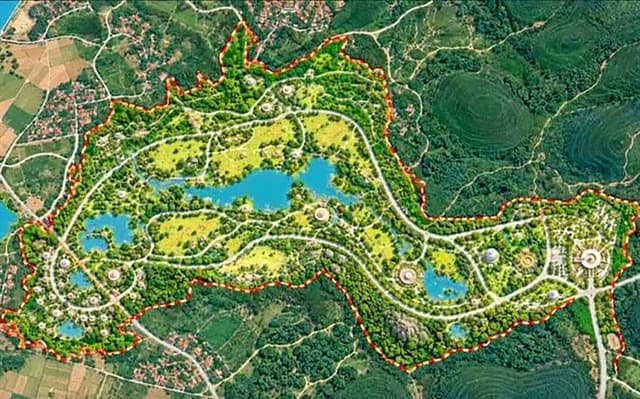
Detailed plans still need to be completed and approved by municipal authorities, an official at the municipal Department of Finance said. The capital is targeting a ground-breaking ceremony around October 10, marking the 72nd anniversary of Hanoi's Liberation Day. The decision was made under Resolution 29, recently issued by the Executive Committee of the Hanoi Party Committee, after it approved a proposal submitted on October 3. The Party Committee instructed relevant agencies to review and complete the project dossiers and carry out the required procedures in line with regulations. Hanoi authorities must also improve public communication and engagement to build consensus and prevent complaints, particularly among residents in areas that could be affected by administrative boundary adjustments between the capital and Phu Tho Province. The municipal Party Committee's Inspection Commission was asked to strengthen supervision from the outset. The municipal People's Committee must regularly report progress and difficulties to the city's Party leadership.
The Safari Park is part of the proposed Ba Vi Ecotourism Complex. The project was initially proposed by private company Sun Property Group, affiliated with Sun Group, under a special mechanism in the new Capital Law. Under the original proposal, the project would cover more than 580 hectares, with preliminary investment of about VND10 trillion, or US$384 million. Around VND1.5 trillion would come from the investor, while VND8.5 trillion would be mobilised from other legal sources. The project is expected to be carried out in two phases. Phase 1, covering about 251 hectares, is scheduled from the fourth quarter of 2026 to the fourth quarter of 2028. Phase 2, covering approximately 330 hectares, would begin in the fourth quarter of 2027 and continue until the first quarter of 2030. Once fully completed, the park was initially expected to receive about 10 million visitors a year. Its commercial opening was planned for early 2030. Under the preliminary plan, the maximum built-up area would be about 72.8 hectares, with an actual construction density of around 13 per cent. Buildings would range from one to five storeys depending on their functions. Green spaces and water surfaces would account for about 446.89 hectares, or 76.95 per cent of the project area. This would include themed parks, landscaped areas, water bodies and buffer greenbelts. The remaining land would be used for commercial and service facilities, tourism services, research, training and education, entertainment and animal experiences, as well as technical and transport infrastructure.
Project footprint under review
After the Hanoi Department of Finance published information about the proposal, the city established an appraisal council to review the investment policy. The project is classified as a Group A project. At a municipal administration press briefing earlier this week, Do Thu Hang, deputy director of the Hanoi Department of Finance, responded to questions about the livelihoods of residents in the project area. Hang said Hanoi had set a target of annual gross regional domestic product growth of about 11 per cent during 2026 to 2035. The target is part of national efforts to achieve double-digit growth for two major centennial development goals. To meet the target, the city will use its available potential, including in trade, services and tourism, Hang said. At the same time, the city plans to pursue socio-economic development while protecting residents' welfare and legitimate interests. Hang said reducing the project footprint in this historic area after the appraisal reflected that approach. After reviewing land management and use, as well as possible impacts on organisations, households and individuals, the preliminary project area was reduced to about 300 hectares. The exact boundaries and land area will only be determined through detailed planning, the deputy director said. Hang said the city would make information public and consult local communities during the planning process. The project still has to complete several procedures, including detailed planning and approval by relevant authorities. Its final scale and investment components will be determined only after that process.
Sources: Viet Nam News

