
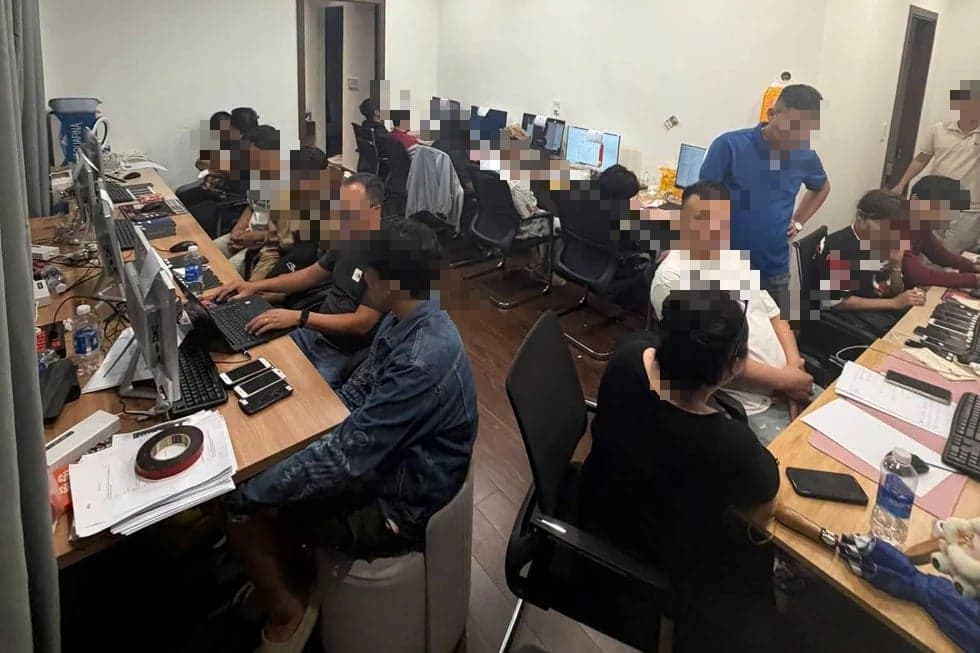
On the evening of November 4, Da Nang police said they had uncovered a group of 13 foreigners who organised online fraud from a rented villa in the R.V. urban area. The site is now in Dien Ban Dong Ward, Da Nang City.
The investigation began after Dien Ban Dong police reported suspicious signs at the villa. Officers from the criminal police, cybersecurity police and immigration police inspected the property and found that at about 9:30 a.m. on October 28, 13 foreigners were using computers and other electronic devices for activities showing signs of fraud.
According to preliminary police findings, X.Z., a 33-year-old Chinese national, led the group and directly organised its operations. A.A.P., a 25-year-old Indonesian national, was the team leader and assigned work to 10 other Indonesians. H.S., a 34-year-old Chinese national, was responsible for cooking, shopping and household service for the group.
$60,000 spent to set up the scam operation
According to the preliminary investigation, X.Z. entered Vietnam from China on August 27 and then went to Da Nang to find a place for online fraud.
On September 9, X.Z. rented a villa in the R.V. urban area, installed an internet connection, and equipped it with 12 desktop computers and 87 mobile phones.
X.Z. also recruited 11 Indonesians to work in Vietnam, met them on arrival, arranged their accommodation and kept their passports. Total spending on workers, equipment, customer data, accounts and operating costs was about $60,000.
X.Z. promised each worker a salary of $700 a month and a $200 attendance bonus. Workers faced fines of $400 to $1,000 if they failed to meet sales targets. Groups with sales of at least $10,000 received bonuses of 5% to 13% of revenue.
From October 1, the workers were split into five groups of two. Under A.A.P.'s direction, they used WhatsApp and Telegram to contact customers, start conversations and sometimes pose as women to build trust with victims in Indonesia.
The suspects then persuaded victims to visit a website, register and deposit money to complete online order-payment tasks in exchange for commissions. Some members contacted about 50 customers a day.
At first, the victims received their small deposits back with a commission. After gaining their trust, the suspects persuaded them to deposit larger amounts and then used various excuses to demand more transfers. They also interfered with the system to prevent victims from withdrawing their money.
To receive and move the money, X.Z. created two separate Telegram groups. One shared Indonesian bank accounts for receiving victims' money, while the other arranged refunds to maintain trust.
A.A.P. provided account details to the workers, received transaction records and reported directly to X.Z.
After victims transferred money, transaction details were posted in an internal group. People whose identities have not been established used an automated Telegram tool to convert Indonesian rupiah into the cryptocurrency USDT. At the end of each day, all income and spending were tallied, converted into USDT and sent to a crypto wallet provided by X.Z. The transfer fee was 3% of the total amount stolen that day.
Da Nang police are continuing the investigation and will handle the case in accordance with the law.
Sources: Thanh Niên

