
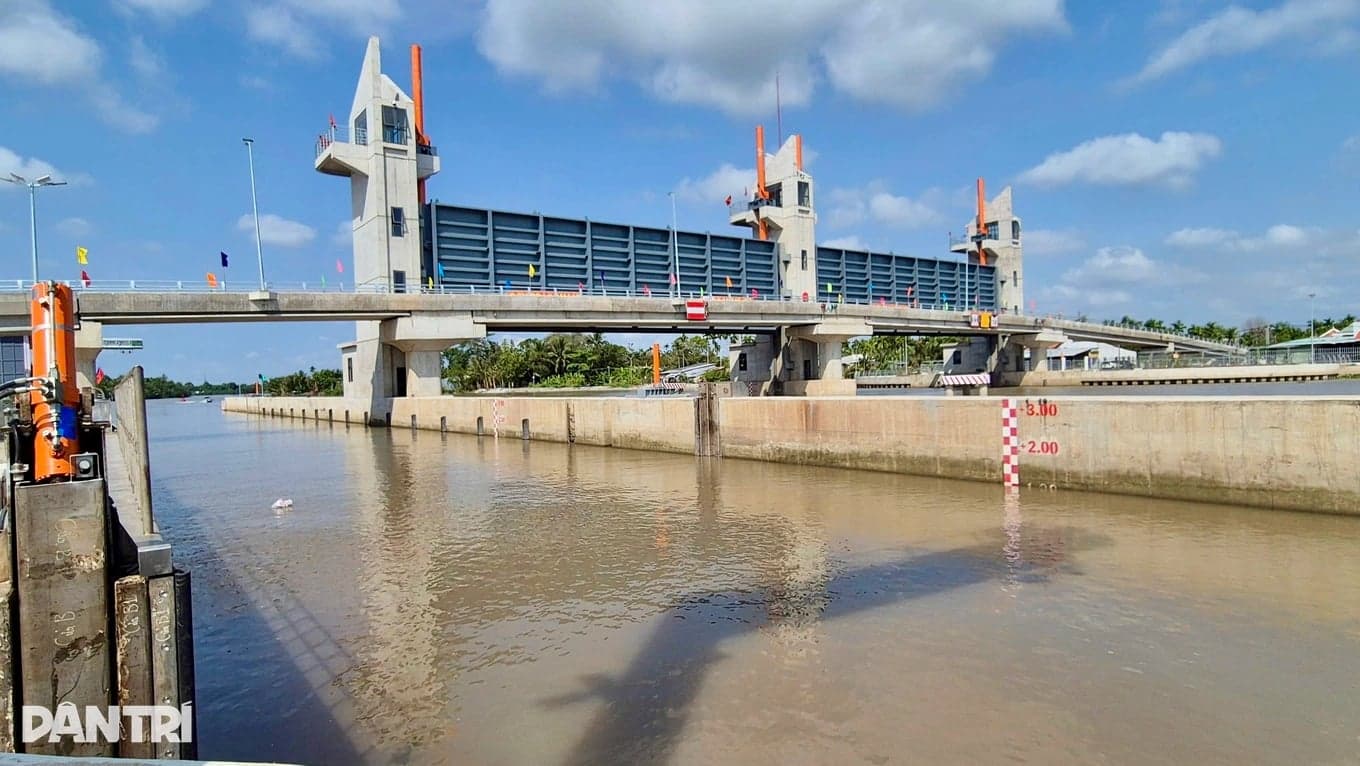
On October 23, the Can Tho People's Committee said the city chairman had ordered departments and local authorities to tighten groundwater controls, store water in rivers and canals in advance, and adjust farming schedules because of drought and salinity risks linked to El Niño.
According to the Can Tho People's Committee, water-resource management in the city still faces several shortcomings. Unregistered and unlicensed groundwater extraction continues.
Many unused boreholes have also not been properly sealed, creating risks of groundwater depletion and pollution.
Coordination between agencies and levels of government is sometimes slow, inspections of violations are not regular, and water-supply infrastructure in some suburban areas remains incomplete.
Because of the risk of water shortages linked to El Niño, the Can Tho People's Committee chairman ordered departments and local authorities to urgently implement coordinated measures. Specialists must monitor weather and hydrological bulletins continuously so they can maximize freshwater storage in reservoirs, rivers, canals and waterways during the rainy season.
The agriculture sector was asked to work with the Department of Construction and commune-level authorities to advise the city committee on extracting surface water and groundwater in a combined or alternating system.
Authorities must also review the possibility of increasing the capacity of centralized urban and rural water-supply facilities that draw from groundwater, allowing them to exceed normal extraction capacity during severe drought and serious water shortages. Drinking water for medical and educational facilities and high-value crops should be prioritized. Authorities must ensure residents do not run out of household water.
The city also ordered a review of proposals to build, upgrade, repair and expand centralized rural water-supply facilities so they meet actual needs.
Can Tho will also strengthen inspections and strictly penalize unauthorized exploration, well drilling and groundwater extraction to protect water resources for residents and socio-economic development.
Water-level and salinity forecast
The National Center for Hydro-Meteorological Forecasting said total flow into the Mekong Delta from November to December is forecast to be 5–15% below the long-term average. In January 2027, flow could be 10–25% below the long-term average.
Water levels in the upper Mekong are expected to fall gradually and be strongly affected by tides. At downstream stations, levels in late October and early November could reach warning levels 2–3 and exceed level 3 in some places.
Water levels in the upper Mekong will fall in January 2027. From February through April 2027, they are expected to remain low and be strongly affected by tides.
The hydro-meteorological agency said salinity intrusion in the Mekong Delta could begin earlier in 2027, become more severe than the long-term average and exceed the level recorded during the same period in 2026.
Sources: Dân Trí

