
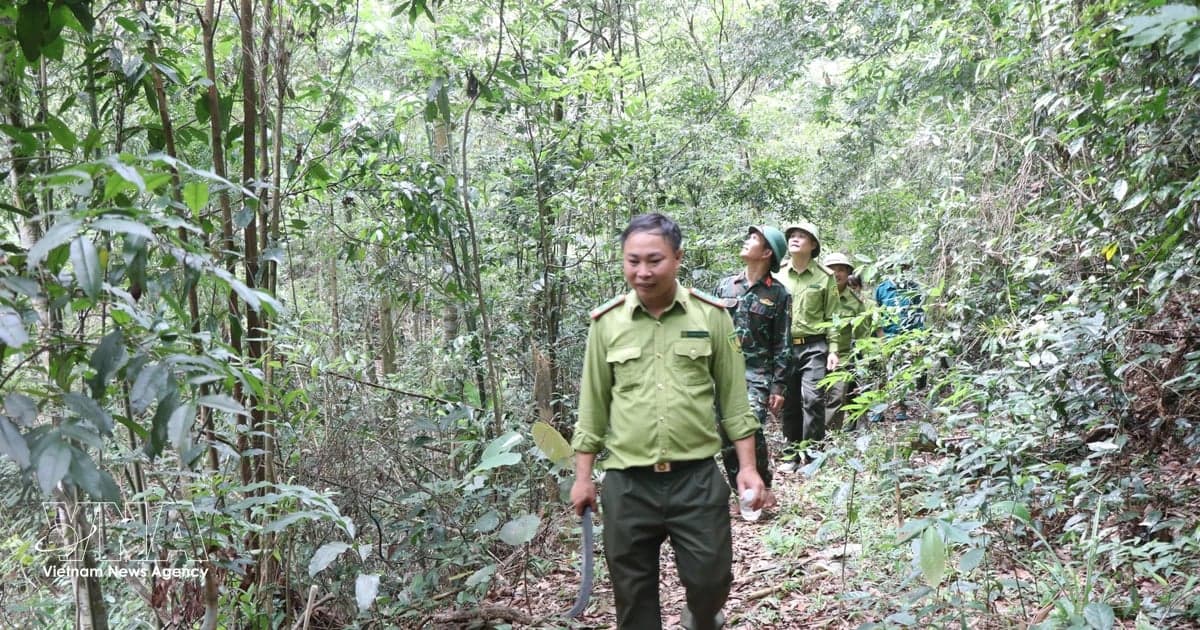
The northern city of Bac Ninh is giving local residents responsibility for protecting forest areas and encouraging the use of technology to monitor them and prevent violations.
For ethnic minority residents in Bieng hamlet of An Lac commune, natural forests provide water and non-timber products and have been part of local life for generations. Protecting them has become a shared responsibility.
Residents now patrol the forests, monitor changes and report violations instead of relying mainly on government authorities.
An Lac has more than 11,932 hectares of forest land, with forest cover reaching 82%. Eight community forest protection teams monitor 2,395 hectares of special-use natural forest managed by the Tay Yen Tu Conservation Area Management Board. The rugged terrain makes patrols difficult.
The community teams recently pooled more than 34 million VND (1,300 USD) to buy a drone for forest patrols in the Khe Ro area.
Vu Ngoc Huan, head of the Bieng hamlet community forest protection team, said outsiders had entered the area to harvest timber and brought fire into the forest. Team members now patrol regularly, especially early in the morning, late in the afternoon and on days off. They also raise awareness about preventing illegal logging and exploitation.
Each patrol can involve 10–12 hours of walking, Huan said. Drones let the teams inspect remote areas more quickly and identify unusual signs, possible forest fires and threats to forest resources, saving time and effort.
An Lac has assigned 699.6 hectares of natural production forest to 126 households, individuals and residential communities for protection. Coordination among the relevant forces helped ensure that no natural forest fires occurred in the commune during the 2025–2026 dry season.
Community forest protection teams in Nang and Mau hamlets in Tay Yen Tu commune and Dong Vanh hamlet in Luc Son commune have also bought drones.
The initiatives show that clear responsibilities and benefits for local residents can encourage communities to take a more active role in protecting forests.
Improving forest protection arrangements
In 2026, Bac Ninh was assigned a target of placing 40,000 hectares of forest under protection contracts. By September, nearly 33,000 hectares had been covered, or 82% of the target. Some forest areas have yet to be allocated or leased.
Since the beginning of the year, the municipal Department of Agriculture and Environment has urged local authorities to speed up reviews of unallocated forest land. All 69 communes and wards with forests have completed their reviews and submitted reports.
The reviews identified about 200 hectares of natural production forest in Duong Huu commune that remain unallocated or unleased, 55 hectares of natural forest in Dai Son commune and 0.86 hectares of planted protection forest in Tam Son ward.
Local authorities face disputes and encroachment on some land transferred from former forestry companies. Boundaries are unclear, and some plots are small or scattered.
Complex terrain makes surveying and documentation difficult, while inconsistencies between forestry and land regulations have slowed progress.
Phi Thanh Binh, deputy director of the Department of Agriculture and Environment, said the department is working with local authorities to compare forestry, cadastral and planning data, carry out field inspections and determine forest origins, boundaries, classifications and eligible recipients.
Disputed areas must be verified and resolved before allocation or leasing. Unallocated forests must be closely monitored. The department is guiding commune-level authorities through the procedures, requiring boundaries to be marked on the ground and management records updated.
The city continues to provide forest protection support of 1–1.2 million VND per hectare annually, higher than previous levels.
In the coming months, local authorities will accelerate forest allocation and leasing to meet the 2026 target, strengthen community protection teams, expand technology use for monitoring and identify effective models to encourage wider participation.
Sources: VietnamPlus / Vietnam News Agency

