
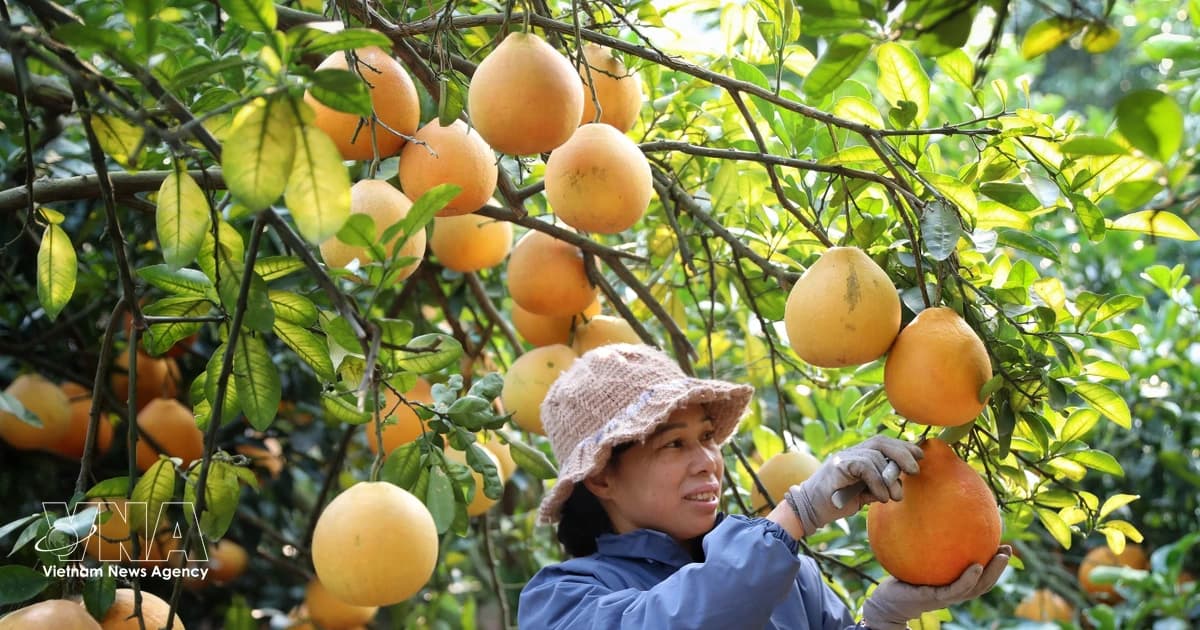
Bac Ninh is expanding pomelo cultivation under quality standards and preparing shipments to China, the US, the Republic of Korea and other foreign markets.
Careful cultivation and technical management help orchard owners maintain stable tree growth and consistent fruit quality.
For years, Nghia and his wife have not needed to take their produce to local markets because buyers purchase the ripe harvest directly at the orchard. This year, their orchard is expected to produce nearly 5,000 pomelos. Each fruit is priced at 20,000 to 30,000 VND, and revenue is expected to exceed 125 million VND, or nearly 4,800 USD.
Throughout production, Nghia and neighbouring growers use organic fertilisers and record every cultivation step. This helps them obtain production-unit codes, meet traceability requirements and expand their markets.
In the Tan Truong residential zone of Chu ward, Tran Dinh En cultivates pomelo on about 1.5 hectares. His orchard has more than 700 trees and produces around 50,000 fruits each year. Revenue exceeds 1 billion VND, and the orchard creates seasonal work for four to seven local workers.
In Luc Son commune, Le The Long has found a niche in the gift market. He grows pomelos shaped with auspicious words: Phuc, meaning happiness, Loc, meaning prosperity, and Tho, meaning longevity. The fruit is especially targeted at demand before the Lunar New Year, or Tet.
Several large orchard owners combine fruit sales with agritourism and offer farm tours to generate additional income.
The economic return from pomelo cultivation is becoming more visible. Annual pomelo revenue across the city reaches about 1.8 trillion VND, while many orchards earn from several hundred million to billions of dong per season. According to the municipal Department of Industry and Trade and local authorities, orchard owners are creating jobs for rural workers as well as increasing their household incomes.
This year, Bac Ninh has about 5,200 hectares of pomelo, nearly 45% of the city’s total fruit-growing area. Output is estimated at 47,000 tonnes, up from the previous year. About 3,660 hectares, or more than 70% of the area, follow VietGAP standards, while another 10 hectares meet organic standards.
Growers use varieties with different ripening schedules to extend the harvest season and reduce pressure from a concentrated supply.
Hoang and Da Xanh, or green-skinned varieties, are now being harvested from September to November 2026. Dao Duong, Dien and Suu will follow. Tan Lac red-fleshed and Tien Vua varieties are still developing fruit. Their harvest is expected from December 2026 to February 2027 to meet Tet demand.
Vietnam recently signed a protocol to export pomelos to China, opening wider opportunities for shipments. Export-oriented growing areas must also meet stricter requirements for product quality, food safety and origin traceability.
Bac Ninh currently has a production-unit code for a 1.8-hectare orchard in the Tan Truong residential zone of Chu ward. The site serves the domestic market. The municipal Department of Agriculture and Environment is promoting the review and application process for new codes.
The department has applied for new codes for 19 growing zones covering 50.9 hectares in Luc Ngan, Chu, Phuong Son and Van Son. These zones are intended to supply the Chinese market. Authorities are also helping growers improve conditions so they can maintain existing codes and enter markets in the Republic of Korea, the US and New Zealand.
Vu Tri Dong, deputy head of the crop production and plant protection unit under the Department of Agriculture and Environment, said pomelo production must be standardised to meet market requirements, especially for export.
The unit is helping local authorities monitor plant growth, pests and crop diseases, adopt integrated pest management, and increase the use of organic fertilisers and biological plant-protection products, he added.
Alongside technical measures, the department and other relevant agencies continue to invite enterprises to join partnerships for fruit sales and exports. Surveys are being conducted in selected areas to establish trade links and raise the market value of Bac Ninh’s agricultural products, Dong said.
Sources: VietnamPlus / Vietnam News Agency

